

William Sanjour*
Albert Einstein said the definition of insanity is doing the same thing over and over again and expecting different results. We have been “reforming” regulatory agencies over and over again, and over and over again they have failed. Yet, as a result of the recent catastrophic failures of regulatory agencies, politicians and pundits are talking about the same old “Regulatory Reform” again. “Fill the regulatory agencies with honest people who won’t cave in to special interests.” “Give them more money, more authority and more people.” But my experience has shown that by concentrating all legislative, executive and judiciary authority in one regulatory agency just makes it easier for it to be corrupted by the industries it regulates.
I worked for the US Environmental Protection agency for 30 years and lived through many cycles of “Regulatory Reform,” doing the same “reforms” over and over again and expecting different results. I’ve learned that the way to achieve true regulatory reform is to give regulatory agencies less money, less authority, fewer people but more intelligent regulations. The theme of this article is that by dispersing regulatory authority, rather than concentrating it, we would make corruption more difficult and facilitate more sensible regulation.

Why can’t you fill regulatory agencies with honest people who won’t cave in to special interests?
The facetious answer is that there is no civil service exam which can select personnel with such qualities. But the real answer can only be found by looking at regulatory agencies from the inside, which few politicians and pundits are able to do. I’ve worked in a federal regulatory agency for thirty years and I’ve studied and written about why they cannot work as planned. You have to first appreciate what a regulatory agency is supposed to do.
After some catastrophe or new technology, Congress creates a new regulatory agency in a wave of enthusiasm, giving it money and following the same pattern of broad, vague discretionary authority to control the richest and most politically savvy forces on Earth. But the interest of Congress, the press and the public can only be maintained for a few months or years. There are a lot of other things going on. But there is one group whose interest never wanes or wavers. The life, the existence, the future of the regulated industry depends on the pressure it can exert on the regulatory agency. At least that’s what the special interests believe.
The regulated community constantly deals with regulatory agencies through congressional committees, the courts, and meetings with top government officials. This is what the public sees, but it does not stop there. Industry also constantly interacts with individual agency employees at every level, working directly with the field inspectors and permit writers responsible for making regulatory decisions.
For example, the inspector general of the Minerals Management Service concluded that officials in the agency had frequently consumed alcohol at industry functions, had used cocaine and marijuana, and had sexual relationships with oil and gas company representatives (1)
When I was in charge of writing regulations I too was the object of this courtship, showered with flattery, meals, trips, and hints of future employment. People who cooperate with industry also find that its lobbyists will work for their advancement with upper management. Those who don’t cooperate find the lobbyists lobbying for their heads.
This process of regulatory agencies being gradually taken over by the regulated parties has been the subject of academic study for many years and has earned economist George Stigler a ‘Nobel’ prize. The upshot of this research is that regulatory agencies captured by the industries they regulate are worse than no regulation at all since capture gives industry the power of government.
Why can’t agency employees simply do what they’re paid to do by Congress?
Strictly speaking agency employees are not paid to implement the intent of Congress. They are paid to do what they’re told to do (unless its illegal, and they are not the experts on what is or is not illegal.) Only the administrator of the agency has the responsibility and authority to implement the law, and since the administrator is usually appointed by the president and serves at the pleasure of the president, it is ultimately the president who is the recipient of that responsibility and authority and not the agency’s employees.
I was once told, while drafting regulations, to do something which I thought was a blatant violation of Congressional intent. When I raised the issue to my boss, while he didn’t disagree, he said it was not his job to make that call and that the assistant administrator, who gave the order, would have to answer to Congress for it. He never did though. He lied to Congress instead.
What are the resultant regulations like?
BP has admitted, between 2005 and 2010, to breaking U.S. environmental and safety laws and committing outright fraud and paid $373 million in fines. Between June 2007 and February 2010, BP refineries in Texas and Ohio accounted for 97 percent of the “egregious, willful” violations handed out by the U.S. Occupational Safety and Health Administration.
Yet none of this resulted in any oversight of the Deepwater Horizon oil rig that blew up.
The Upper Big Branch coal mine in West Virginia, was cited for 458 safety violations in 2009, with 50 of them listed as unwarrantable failures to comply–citations reserved under federal mining regulations for instances of willful or gross negligence.
Yet the mine continued to operate until an explosion killed 25 miners.
From my own experience with the U.S. EPA, even if an inspector finds a violation, this only triggers a lengthy complex process with many levels of warning, review, appeal, negotiation, and adjudication before any action is taken (or, more often, avoided).
See the labyrinthine flow chart for an example of an agency enforcement procedure. It resembles a game of “chutes and ladders.”
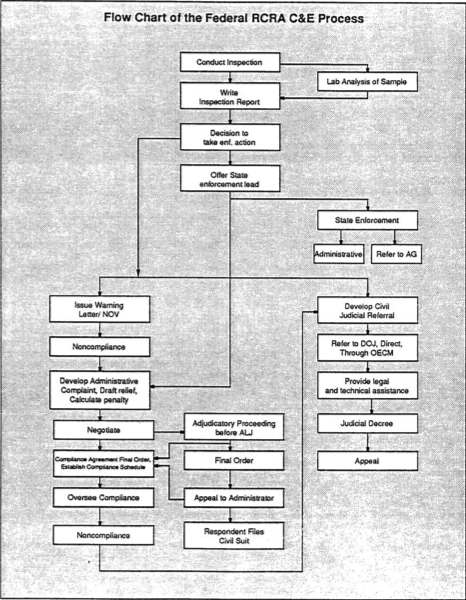
Compare this with what happens when you park under a “No Parking” sign. A policeman writes a ticket, and you can either pay the fine or tell it to the judge. If the EPA wrote the rules for parking violations, the officer would first have to determine if there were sufficient legal parking available at a reasonable cost and at a reasonable distance, and would then have to stand by the car and wait until the owner showed up so that he could negotiate a settlement agreement.
Why are regulations so ineffectual?
The short answer is that regulators are pulled many different ways simultaneously. When I was writing regulations, I was told on more than one occasion to make sure I put in enough loopholes. The purpose of the complexity is to hide the loopholes. It’s not easy for outsiders to understand why this is the case. Here is an explanation I wrote several years ago.
Regulatory agencies are created by Congress in order to control some powerful forces in society (usually corporations), which benefit society but which are also prone to abuse their power. The purpose of a regulatory agency is to allow the flow of benefits while straining out the abuse. In order to do this, Congress gives administrators of regulatory agencies broad discretionary power to write regulations for industries for which they are responsible.
The flaw in the system is that the administrator is appointed by the president and, although confirmed by the Senate, he or she nevertheless serves at the pleasure of the president. Thus any discretionary authority given to a regulatory agency administrator is, in fact, given to the president of the United States to be used as the president sees fit, and the administrator is no more than a White House staffer. Furthermore, the White House has its own staffers who oversee the activities of the agency and act as “shadow administrators.”
As I said, we are dealing with powerful forces. The Food and Drug Administration, the Nuclear Regulatory Commission, the National Highway Traffic Safety Administration [NHTSA], and EPA, among many others, regulate giant corporations.
As you know, big corporations have big power, money, and influence. Corporate money helps elect governors, congressmen, senators and presidents. The threat of a corporation’s withdrawal from a state causes governors to hesitate to enforce the state’s laws.
Congress has essentially given the authority to regulate these powerful giants to a president. A president, however, regardless of party, has an agenda of about a half dozen issues with which he and his staff are most concerned. These are usually national security, foreign affairs, the economy, the budget, and maybe one or two others; call them Class A priorities. All others housing, education, transportation, veterans affairs, the environment are in Class B.
A president, any president, expects performance in Class A. He will expect the military to be able to deploy forces anywhere in the world when he chooses, and if it isn’t, he will bang heads until it is. If Congress doesn’t support his budget, he will call the budget director into his office and pound his fist on the table. But can you picture a president bringing the secretary of transportation into the Oval Office and yelling because of poor bus service in Sheboygan? Or summoning the administrator of the Environmental Protection Agency in and chewing him out for pollution in the Cuyahoga River? I can’t. A president expects performance in Class A; in Class B he expects only peace and quiet. The heads of Class B agencies rarely if ever get to see the president but must deal with White House staffers.
But regulatory agencies, by their very nature, can do little that doesn’t adversely affect business, especially big and influential business, and this disturbs a president’s repose. The EPA, for instance, cannot write regulations governing the petroleum industry without the oil companies going to the White House screaming ‘energy crisis!’ As a result of energetic lobbying by the automobile industry, the NHTSA cannot release the millions of automobile safety complaints in its files. When the FDA wants to thoroughly evaluate a new drug, the pharmaceutical company lets loose a public relations barrage about how the bureaucratic delays are costing lives.
Regulatory agency employees soon learn that drafting and implementing rules for big corporations means making enemies of powerful and influential people. They learn to be “team players,” an ethic that permeates the entire agency without ever being transmitted through written or even oral instructions. People who like to get things done, who need to see concrete results for their efforts, don’t last long. They don’t necessarily get fired, but they don’t advance either; their responsibilities are transferred to others, and they often leave the agency in disgust. The people who get ahead are those clever ones with a talent for procrastination, obfuscation, and coming up with superficially plausible reasons for accomplishing nothing.
OK, we’re going about this the wrong way. What’s the right way?
The reason salaried government regulators can be corrupted is that writing and enforcing effective regulations is not their number one priority. Their main objective is keeping their job and advancing their careers. The reason regulated industries ceaselessly exert pressure to corrupt government officials is that they believe managing their regulators is their only way to survive. Therefore, I believe, the right way to regulate is to remove discretionary judgment from the hands of the regulatory bureaucracy and place it in hands less susceptible to industry influence.
The first thing I would suggest is to make use of people or institutions who have a vested interest in effective regulation as strong or stronger than the regulated community. Here are a few examples.
A recent study of corporate fraud among U.S. companies (3) looked at different groups responsible for fraud detection and found that corporate employees (i.e. whistle blowers) were the leading group with 19 percent of the fraud cases revealed, while the SEC was the least effective group with only 7 percent. This in spite of the fact that SEC employees are paid comfortable salaries to uncover corporate fraud while corporate whistle blowers risk losing their jobs. In the health care industry, the problem is the same. Some 41 percent of the fraud cases are brought by employees because the Federal Civil False Claims Act entitles whistle blowers to between 15 and 30 percent of the money recovered. Monetary rewards for whistle blowers pay benefits far in excess of the cost when compared with hired regulatory bureaucrats.
If BP had been required to carry a $10 billion insurance policy for an oil spill, I’m sure the insurance company would not have allowed the penny-pinching short cuts that the paid regulators allowed. If the laws are written intelligently, insurance companies can be a significant instrument for regulation.
Organizations like Citizens for Health and Environmental Justice and Global Community Monitor teach citizens how to get actively involved in the enforcement of government regulations. For example my friend, environmental activist Denny Larson, founded the Bucket Brigade movement, which helps citizens, living near air pollution sources, get their own resources to test the air quality for themselves and inform EPA enforcement officials if the air is toxic. EPA should be sponsoring this movement as well as sponsoring citizen water pollution testing. Again, if laws are written intelligently, concerned citizens can also be a significant instrument for regulation.
A second reform I would suggest for removing discretionary authority from the regulatory bureaucracy is to make the rules as simple as possible and to place all appellate functions and consent agreements into the hands of the law courts, just as in our traffic cop example. This could be judicial courts or administrative law courts. Anything to take the discretionary authority away from the people who write and enforce the rules and provide one more barrier to industry influence.
So what’s stopping us from doing it the right way?
Almost everything. For starters the enforcement branches of the agency would lose a lot of personnel and authority and they wouldn’t like that. Grades for supervisory civil servants are determined largely by the number and grades of people supervised, not by their effectiveness. Being more efficient with fewer people and a lower budget would mean a lot of demotions and lost jobs.
While the president and other top level politicians would be happy to reduce spending, they would not like to surrender their discretionary enforcement authority. The power to enforce is the power to control. The “chutes and ladders” enforcement structure provides many opportunities for corruption which, if carried to extremes, turns the power of government over to the regulated industries.
And while companies may seek regulations for public relations concerns, the last thing industry wants is competent, efficient regulation that it cannot control.
Back to the Constitution
In their infinite wisdom, the Founding Fathers chose to separate the legislative, executive and judicial functions of government. For some reason, this example was not followed when regulatory agencies were established. Regulations are laws. They have the same weight of law as if they were written directly by Congress. Today, most laws on the books are laws written by regulatory agencies, i.e. the executive branch of government. Furthermore, if you look at the previous chart you see judicial functions are also usurped by the regulatory agencies. Thus, despite the wishes of the Founding Fathers, the executive branch now includes a great many regulatory agencies whose functions span all three branches of government. A large part of the corruption and inefficiency noted above flows from this fact.
How do we get out of this?
Legally: not very difficult. Politically: very difficult. I can only make recommendations about how to go about it legally.
I once asked then Congressman Jim Florio, who was responsible for a lot of the hazardous waste legislation, why Congress gave so much discretionary authority in writing regulations to the Administrator of EPA when they knew he would use it to try to thwart the intent of Congress. Why didn’t Congress just write the regulations it wants in the form of law and limit the Administrator’s job to administration? He said they had no choice. Congressional staffs were too small and overworked to do the detailed work necessary for regulations whereas the Administrator had thousands of people to write regulations. He said that wherever possible, they wrote the laws as specifically as they could, but for the most part, all they could do was write broad statements of what they would like to see happen and give the Administrator the task of writing the regulations to implement their intent.
After some thought I realized it’s not necessary to expand Congressional staffs. The staffs are already there. Let me illustrate using the example of EPA, which I know best. The agency has three functions; regulation, enforcement and research. All regulations come out of the so-called program offices such as the Office of Air and Radiation, the Office of Water, the Office of Solid Waste and Emergency Response, etc. These, along with support services, could be collected into a separate agency, let’s call it the Regulatory Environmental Agency (REA). The rest would still be the EPA.
The act of Congress that established EPA would have to be amended as follows:
1. The president, with the approval of the Senate, would still appoint the administrator of EPA and remove them at his discretion.
2. The administrator of EPA would have all the authority they currently have with the exception of the authority to write rules to implement the law.
3. The administrator of the REA would be appointed by act of Congress and removed by act of Congress.
4. The administrator of the REA would have the responsibility and authority to issue rules to implement the law.
Note that these are all paper changes. They do not require any relocation, new buildings, new hires, etc. The functions all currently exist. They are merely rearranged.
Why would this necessarily result in less corruption and more efficient regulation?
It would not necessarily create better regulations, but it would remove some of the impediments. Being freed from enforcement of their regulations, there would be no incentive for the REA to write rules which protect the jobs and authority of the bloated ineffectual enforcement authorities at the expense of efficient enforcement. While there might still be pressure from Congress and industry to put loopholes in the rules, it would relieve the pressure from the White House and its many auxiliaries such as the Office of Management and Budget, cabinet offices and independent agencies, which, in my experience, have been the greatest source of pressure albeit much of it indirectly from industry. This is not to say that all these agencies would be eliminated from the rule making process, but rather that their input would be advisory rather than definitive, as it is now.
More important would be the relationship between the regulatory agencies and Congress. The removal of impediments would help the REA write more efficient rules, but the REA would still lack authority to do a great deal more unless the authority were granted in legislation.
One of the best examples of this is the use of liberal citizen suit provisions, especially with treble damages. In statutes that have this provision, citizens can hire a lawyer on a contingency fee basis and bring action directly against a violator without having to go through any government agency. If they win, the polluter pays a fine equal to three times the damages that is split between the citizens and their lawyers.
For another example, while whistle blower protection provisions are included in many laws, they are not included in the laws governing offshore drilling and many other laws. In the words of presidential candidate Obama, “Workers are the eyes and ears of enforcement.”
Congress ought to consider not merely protecting whistle blowers, but rewarding them. When a whistle blower’s charges prove correct, they should be given a cash reward in proportion to the importance of the revelation. Whistle blowers cost much less and are far more effective than salaried government enforcement officials.
Additional examples are:
Close the revolving doors. Ban regulators from joining firms they regulate for five years after leaving the agency.
Instead of limiting liability (as Congress did with the oil companies) require liability coverage for the maximum possible damage.
Open government officials up to civil suits for damages caused by the failure to do their duty.
So long as regulations are written by the executive branch of government, these kinds of efficiencies are discouraged because they compete with and reduce the need for government enforcement officials. And when used they make enforcement officials look bad. On many occasions I’ve heard EPA enforcement officials speak disparagingly of citizen activists. I frequently advocated for citizen involvement in our enforcement rules and I was routinely rebuffed.
However, if the regulation writing were divorced from the enforcement there would be no need to protect enforcement jobs. Indeed I, would hope that given this independence, regulation writers would work with the appropriate Congressional committees to develop and promote new efficient, innovative ways to regulate.
To summarize, this is what I believe needs to be done :
1) Agencies which enforce regulations should not write the regulations.
2) The revolving door should be shut.
3) Whistle blowers should be protected, encouraged and rewarded.
4) To the greatest extent feasible, those who the regulations are intended to protect should participate in writing and enforcing the regulations.
Footnotes
(1) http://www.doioig.gov/images/stories/reports/pdf/RIKinvestigation.pdf
(2) U.S. Environmental Protection Agency, Office of Solid Waste and Emergency Response, The Nation’s Hazardous Waste Management Program at a Crossroads, The RCRA Implementation Study [EPN530SW90069] (Washington, D.C.: U.S. Environmental Protection Agency, Office of Solid Waste and Emergency Response, July 1990) p. 59.
(3) Dyck, I. J. Alexander, Morse, Adair and Zingales, Luigi (2010) , Who Blows the Whistle on Corporate Fraud? The Journal of Finance LXV (6) 2213-2253
* William Sanjour retired from the U.S. Environmental Protection Agency in 2001 after 30 years, most of it spent in regulations. He has written and published articles about why regulatory agencies don’t work and what can be done about it. He has have been invited to testify at numerous Congressional hearings and at state legislatures and citizens groups around the country as well. He presently sits on the Board of Directors of the National Whistleblowers Center. This article and others can be found on the Web at http://sanjour.info.
If this article was useful to you please consider sharing it with your networks.

Why did our current President, campain to champion whistleblowers, then allow persecution of them?
Everybody loves whistleblowers — but not working for them.
No business allows decision making in the field. Field inspection is reporting facts w/ analysis by independent committee off-site, due to environmental pressures on-site. Remove the soft target,
remove corruption. That simple. Remove transparency. EPA has been played.
If violators faced answering to Congress, twice removed from site, fraud is reduced. Old habits die hard. Hit the re-set button! USA can’t afford sloppy tactics in business “climate” control.
Great insights! Thank you.
The EPA has been co-opted, same as our lawmakers. It’s what the Founding Fathers feared when they sought to restrict the creation as well as the power of corporations. It took a hundred years or so, but in time, the powerful corporations (starting with the railroads) found a way not only to circumvent the restrictions but to turn our very Constitution, meant to protect The People (real, natural, living people) on its head and use it against us.
It is a good discussion and it is heartening to see such intelligent people concerned about one of the biggest UNDERLYING problems facing our country today.
Great article, thanks for making these points.
Trouble is that as reasonable as the author’s recommendations are, at least in the US they are very hard to follow, other than at a huge cost.
For instance, nothing could be more desirable than protecting whistleblowers, yet the fact is that the Obama Administration, allegedly less ‘business oriented’ than other Republican administrations, has prosecuted more whistleblowers than any other in US history.
Indeed, these days anybody who threatens the bottom line of Corporate America, or the goal of ‘spreading democracy’ through the military, is likely to end up in jail, or worse. (see the case of NSA whistleblower William Binney, http://www.democracynow.org/2012/4/23/more_secrets_on_growing_state_surveillance).
Pity because the solutions, as the author lays out so well, are not rocket science. But given the circumstances it’s hard to know how to get from here to there.
Corporations control Congress every bit as much as they control the President. Shifting oversight from one place to another within the government will do nothing to stop the corruption. The ONLY THING that will free the people from the pernicious control of greedy corporate power over their lives is to reverse the obscene misinterpretation of the Constitution that is currently granting corporations “personhood”under the Constitution. That is what gives corporations their power to run roughshod over the rest of us. If you don’t take back the Rights of Natural Persons OVER corporate entities, all the rest is like shifting the deck chairs on the Titanic. Their control is pervasive and effective, and our only legal hope short of revolution is to get rid of corporate “personhood.”
But good luck — since corporations control the Supreme Court as well.
Meanwhile, regulations are a cattle chute — they only thing they regulate is the ordinary citizen’s ability to DO anything about the pollution and destruction of our environment, safety and personal health. We can’t stop corporate destruction — we can only whine about keeping the destruction contained within the overly generous boundaries prescribed by regulations.
Hi Karin
Thanks. No disagreement: but your comments appear to apply to the USA, while the article is applicable, and will be read, in many other countries. Also, I would say that if you want to fix a broken system you need to know what you want for each part. Moreover, if you want to offer links to people working on these issues, we will post them.
Yours Sincerely
JRLatham
True, I was only addressing the issue in the U.S. But my approach to one piece at a time says that any incremental changes you make on one aspect or another wil be circumvented and wasted energy if you don’t FIRST fix the underlying problem of corporate “personhood.” Until that is changed, the rest is moot and we are expending our energy for the best motivations in ways that will always be ineffectual. That’s just what those corporate powers want — take the smartest, best-informed and most motivated good people and direct their energies in ways that make almost no impact on corporate power over our lives.
Check out the Democracy School, which together with their parent organization, the CELDF (Community Environmental Legal Defense Fund) is having terrific success in helping individual communities officially deny corporate personhood. They do this knowing that if they are challenged, they will lose and have to appeal — but if there are hundreds of communities all over the country, all standing up and saying NO MORE, and they all push it right to the top, something has to give. Pittsburgh was the first big town to go this route, but it’s spreading.
My personal preference is for a constitutional amendment that ends corporate person-hood AND limits campaign contributions to citizens AND requires a balanced budget. That puts limits on both government and corporate abuse and draws support from a broad range of the public. A populists dream.
Me too! And as we have learned, even though passing the first SHOULD eliminate the second, it’s not a bad idea to spell it out.
Excellent points and clearly made – thanks for writing this. Your experience can be echoed by anyone who has done time in the federal regulatory machine.
One distinction that many environmental activists don’t understand is the difference between regulations that protect public health and environment and those that set standards for market development purposes. This is most of what USDA does – primarily product quality standards that benefit the regulated industry by limiting competition from ‘inferior’ product grades. Unfortunately the public’s demand for higher standards for organic agriculture has worked to limit the environmental benefits of wider adoption of organic practices and served the corporate-organic interests of limiting access to a tightly controlled and expensive regulatory system.
Would love to hear your thoughts about this —
I’m not sure how the public’s demand for higher standards has limited wider adoption of oranganic production, unless you are saying that we should lower the standards for what is allowed to be labelled organic. That’s such a false picture — it allows greedy and destructive corporations to APPEAR to be producing safe and healthy food when they are not, blurring the lines with people who are truly growing healthy food.
As a person with 2 close driends doing truly organic farming locally, I can say that in general, the problem is the lowering of the standards. You also see the setting of impractical and sometimes counterproductive standards in one way, while allowing things which should not be allowed in another way. Just more obsfucation to allow corporate ag to prevent the spread of healthier food production, or if they can’t beat it out, to co-opt it as their own — and then corrupt it into meaninlessness.
I have another very good friend who works for the USDA — her job involves approving NMPs for corporate agribusiness. Once again, the regulations are written to favor industry, and are totally lame, when they are even enforced — which they seldom are. I could describe all the loopholes built into that system that allows corporate ag (I am thinking specifically of dairy here) to do pretty much whatever they want with no checks or balances. In this way, they effectively tie the hands of the citizens whose health and communities are being damaged by these practices — so long as they appear to be within the boundaries of the “regulations” — no one can do a thing about their destructive practices.
I go back to my point that the regulatory system does not work, and it does not work because powerful corporations see to it that it does not work. Until you take that power away from them, you can set regulations any way you want — they will find ways to circumvent and nothing will change.
I don’t know how the “public’s demand for higher standards for organic agriculture” is conveyed to NOP administrators. The fact is that the National Organic Standards are already extremely rigorous and meaningful. After over a decade of observing and participating in the organic movement, it is my conclusion that the organic certification process need to be made more farmer-friendly so as to welcome more growers to certification. As Grace notes, changes to the organic standards have been made on behalf of corporate food processors, primarily, and secondarily on perceived demand by consumers. When will the farmers themselves be given a truly consistent and accessible organic standard? Meanwhile, the energy of the fresh/local food movement is racing past certified organic, whose administrators seem to devote their time to finding more little nits to pick than to truly improving organic.
Separating the regulation from the enforcement authority is absolutely the right thing to do (which is why it probably won’t happen). I would suggest that requiring liability insurance for worst case contamination scenarios, as a primary regulation would align the interests of the insurance industry with the public and would cause a rapid shift that goes way beyond strict compliance. I’m not sure of the difference between a whislteblower and a disgruntled employee looking to cash out.
CASH OUT! Do you have any idea of the persecution a whistleblower endures when he takes on big business or big government. Check out http://www.whistleblowers.org/
Regulatory bodies and enforcement agencies are equally susceptible to pressure and/or corruption from the industries they seek to regulate — as is Congress. Sounds like shifting the deck chairs to me — sadly.
Karin,
If I can make an analogy; would you like the district attorney’s office to be part of the police department and the police department to also write the laws it enforces? That’s analogous to the situation that exists in most regulatory agencies.
Karin: I would say that regulations are perfectly capable of working, provided that regulatees accept the specifics of decisions made and the concept of regulation itself. This occurs elsewhere, for example it’s more common in Europe, which has banned routine use of antibiotics in farming, rbGH, atrazine and other technologies, (Though it is changing there too). Problems, however, occur when the regulated industry does not accept its role or goes over the head of an agency, e.g. to Congress.The suggestion made here strengthens the system to work as it should, given an industry reluctant to comply.
Another interesting point here is that food safety advocates have been pushing for a unified food safety and so too now is the American Enterprise Institute:
http://www.foodpolitics.com/2012/04/american-enterprise-institute-advocates-single-food-safety-agency/
That means probably the food industry itself wants it (they fund the AEI) and so they see nothing scary in that scenario. Which would fit with Bill’s thesis: a single agency is easier to corrupt. Perhaps food safety advocates will modify their request if this article gets read?
William: I don’t argue that the situation of having the regulators be the same as the enforcers is fine. I just say the corruption is so pervasive that what would solve the problem in a normal world won’t solve it here.
JR: Some regulations can work. But in many circumstances what is needed is just plain NOT doing something damaging. Regulations allow damage at a slower rate is all, and prevent citizens from accomplishing what they need to accomplish — i.e. stopping the damage. Because so long as industry only commits damages within the allowable rates, there’s nothing anyone can do to stop it. Follow? That’s what I mean when I say that the regulatory system is a cattle chute — and we are the cattle.